

Tirinkatar Sacred Valley: Armenia’s High-Altitude Valley of Dragon Stones
This article recounts our journey to Tirinkatar in mid-October 2025, to one of Armenia’s oldest archaeological sites. Perched at 2,850 meters, the sacred valley is home to 12 vishaps—ancient Dragon Stones—spread across a 40-hectare core, offering a glimpse into Armenia’s earliest monuments.
Some trips feel routine. Others turn into stories you remember for life. Tirinkatar was the second kind.
In September 2025, Barbara from the Netherlands contacted me with a request that instantly stood out. She wanted to visit Karahunj, ROT54, and Tirinkatar. ROT54 and Tirinkatar were closer to Yerevan and in one line, so we focused on them. To say I liked her choices would be an understatement. In all my years of guiding, this was the first time a traveler from abroad had specifically asked to visit Tirinkatar.
Me in the Tirinkatar sacred valley, standing near a famous dragon stone, back in 2022
Just days before coming to Armenia, Barbara had returned from Georgia, where she took part in the traditional seasonal horse migration between the high Caucasus of Tusheti National Park and the semi-desert lowlands of Vashlovani. That already said a lot about the kind of traveler she was. On October 14, we set off.
The Road to Tirinkatar
The weather was on our side that day—clear skies—though fresh snow still covered the higher slopes from earlier storms. After exploring the ROT54 radio telescope and its controls room, we passed Amberd Fortress and the challenging road started.
I had been to Tirinkatar before, back in 2022. That time, I parked near Amberd and hiked roughly 14 kilometers one way. This time, we drove all the way to Tirinkatar in my Mitsubishi Pajero 4. Honestly? It was the worst road I have ever driven in Armenia.
Deep ruts, slippery sections, and endless rocks made every meter a challenge. After a long and exhausting drive, we finally reached the slopes of Tirinkatar. In the end, it became too slippery, so I parked the car on the foot of mount Tirinkatar.

My Mitsubishi Pajero 4 parked in the Tirinkatar sacred valley, biblical mount Ararat creates a dramatic backdrop
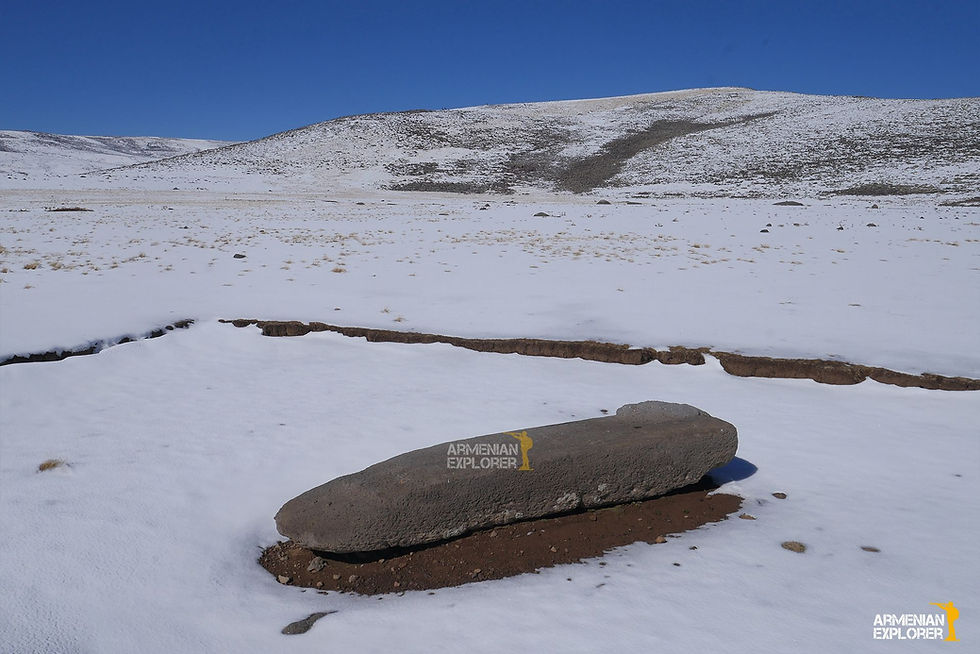
The sacred valley was already covered in snow. Luckily, I had marked the coordinates of every known dragon stone in advance. Step by step, we began discovering them one by one.
What Are Vishaps (Dragon Stones)?
Vishapakars or vishaps are monoliths commonly found across the Armenian Highlands. They are located at high altitudes, near natural and artificial ponds, highland lakes, and other water sources, and are closely associated with the worship of water.
Over 150 vishaps are known today
About 90 of them are located in modern Armenia

With Barbara we are exploring the Tirinkatar sacred valley
They are usually found at high altitudes, near springs, river sources, or ancient water reservoirs, typically between 2,000 and 3,000 meters above sea level.
Archaeologists believe vishaps symbolized water, fertility, abundance, and the life-giving forces of nature. This fits perfectly with their location—almost always tied to water.
Tirinkatar (Karmir Sar): The Summit of the God Tir
Tirinkatar means “Summit of the God Tir.” Local shepherds also call it Karmir Sar—“Red Hill.”
The site lies on the southern slopes of Mount Aragats, near the sources of the Amberd River, at an altitude of around 2,850 meters above sea level and covers about 100 hectares. The core archaeological zone, spanning roughly 40 hectares, contains 12 vishaps.
The plateau offers breathtaking views of Mount Aragats and Mount Ararat and has always been rich in grass and water, making it an ideal summer pasture.

Discovery and Scientific Research
Although the surrounding area was mentioned over a century ago by Armenian archaeologists Ashkharbek Kalantar and Grigor Ghapantsyan, the archaeological site of Tirinkatar itself remained unknown to science until 2012.
That year, a joint expedition of the Institute of Archaeology and Ethnography of the National Academy of Sciences of Armenia and Ca’ Foscari University of Venice identified a new high-altitude archaeological complex.
Since then, systematic research has been carried out by an international team led by:
Dr. Arsen Bobokhyan (Armenia)
Dr. Pavol Hnila (Free University of Berlin)
Dr. Alessandra Gilibert (Ca’ Foscari University of Venice)
During the 2013–2014 excavations, archaeologists documented the following findings.
12 basalt vishaps were documented in their original archaeological context
Some reach up to 5 meters in height
They are carved as fish, bull, or hybrid forms
For the first time, the pits where the stones originally stood were excavated and studied
This confirmed Tirinkatar as the largest known concentration of vishaps in one place.
Dating the Vishaps
Radiocarbon dating of organic material found around the stones finally settled a long debate.
• Main period of use: Chalcolithic and Early–Middle Bronze Age
• Approximate dates: 4000–2000 BCE
This makes vishaps among the oldest monumental stone artworks in the Caucasus.
Archaeobotanical Breakthrough
At an altitude where no one expected it, archaeologists discovered:
Charred bread wheat
Hulled barley
Emmer
These remains represent the first evidence of cultivated plants found at such a high altitude in the region. They were likely ritual offerings used during ceremonies.
More Than Just Dragon Stones
Tirinkatar is not a single monument—it is an entire sacred landscape. The site shows continuous human activity from the Neolithic period onward, with strong ritual use during the Bronze Age.
Here you can find:
Cromlechs and stone circles
Petroglyphs depicting animals and symbols “Giant houses” – large dry-stone structures used by seasonal herders
Burial mounds
Modern cult sites, including the so-called Ziyarat which stands a syncretic sanctuary by various ethnic and religious groups

At the summit of mount Tirinkatar stands a syncretic sanctuary used as a Ziyarat by various ethnic and religious groups
UNESCO Recognition
Tirinkatar’s vishaps and cultural landscape are included in UNESCO’s Tentative World Heritage List as a remarkable example of megalithic culture in the Armenian Highlands.
Final thoughts ...
Standing there in the snow, surrounded by silence, wind, and ancient stone, Tirinkatar does not feel like a ruin. It feels alive.
Few people ever reach this place. Fewer still understand what they are seeing. That is exactly what makes Tirinkatar special.
It is not an easy destination. The road is rocky and requires a high clearance car. The weather is unpredictable. But for those who make the effort, Tirinkatar offers something rare: direct contact with one of the oldest sacred landscapes in Armenia.
And for me, guiding someone who truly wanted to be there made the journey even more meaningful.
Լուսանկարներ


Դիտել նաև․․․
How to Visit ROT54 (Aragats Scientific Center) – Full Guide

Shvanidzor’s 17th-Century Aqueduct: Armenia’s Ancient Engineering Marvel

Grigor Khanjyan’s Monumental Fresco at the Yerevan Cascade

From Stendhal Syndrome to Suren Syndrome

Tirinkatar Sacred Valley: Armenia’s High-Altitude Valley of Dragon Stones

How to Choose a Local Guide in Armenia

Komitas Pantheon in Yerevan

Gallery of Mineral Waters in Jermuk
