

A Visit to a Soviet-Era Aviamodeling School in Armenia
This article takes you to one of the Soviet-era aviamodeling schools still operating in Armenia. The school has never undergone renovation and remains almost unchanged, like a time capsule—a living museum that continues to function to this day, with children still attending classes. The article also provides a brief overview of the role and purpose of aviamodeling schools in the USSR, including their development in Armenia.
Children’s aircraft modeling (aviamodeling) in the Soviet Union was a widely developed educational and recreational movement that combined technical creativity, patriotic education, and early career orientation in aviation and engineering. It emerged as part of a broader state policy aimed at promoting science and technology among young people and played an important role in preparing future specialists for industry and defense.
Specialized magazines were published, and modeling clubs operated in almost every city and town, even in very small communities. Both children and adults built aircraft models by hand and took part in city, regional, all-Union, and international competitions.
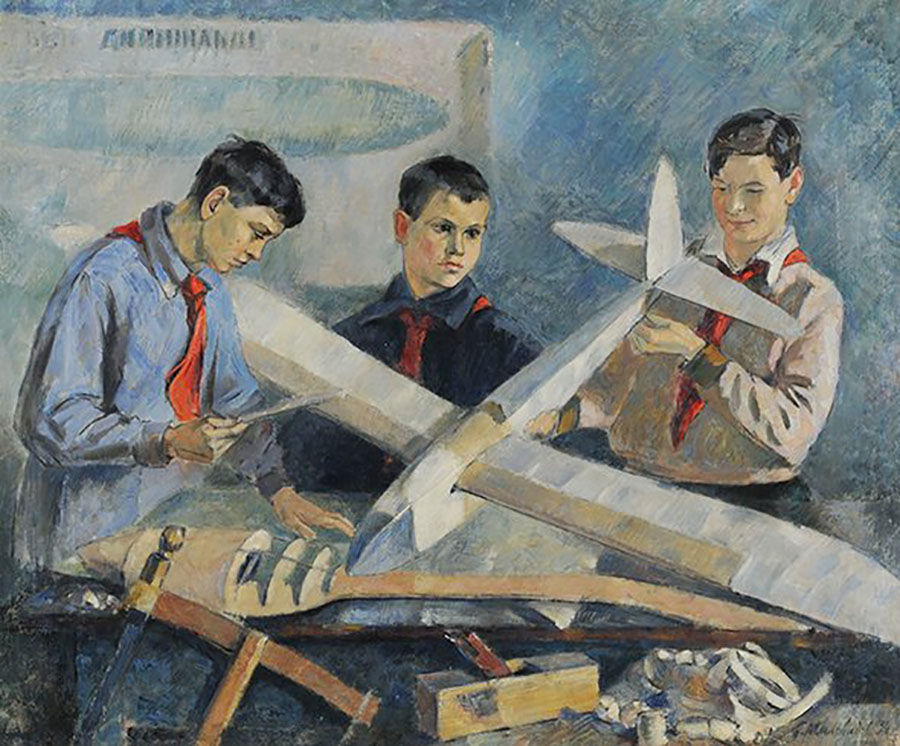
Even artists were inspired by this, and it is no surprise that Boris Milovidov’s painting “Aircraft Modelers” (1934) emerged as a reflection of this movement
How it started in the USSR
The year 1923 marked the beginning of mass aircraft modeling in the Soviet Union. In many cities across the USSR, aircraft modeling and glider-modeling clubs and training courses were established. The first instructional brochures on aircraft modeling were published, instructor training programs were launched, and competitions for flying models were organized.
In 1925, two aircraft modeling schools were formally established: one in Moscow and one in Transcaucasia. These schools were later merged into a single institution.

An old photograph of Armenian children at an aviamodeling school
At the end of 1952, Soviet aircraft modeling sport was incorporated into the unified system of officially recognized sports activities overseen by state authorities responsible for the development of sports in the USSR. From that point on, aircraft modelers became eligible for official honors and awards, including national championship jerseys and the titles of Master of Sports and Honored Master of Sports.
In 1974, the Central Sports and Technical Club of Aircraft Modeling of DOSAAF of the USSR was established. It operated until 1992. Today, its legal successor can be considered the Moscow Aircraft Modeling Club of the Moscow City Organization of ROSTO (DOSAAF), known as MAK.

The teacher, Gagik, who worked here for decades, patiently demonstrated and explained the aircraft models
Several main types of models existed:
• Free-flight models (gliders).
• Controlled models (control-line and radio-controlled). Control-line models were often used for air combat simulations and racing.
• Scale replicas of real aircraft.
• Static display models (non-flying scale models).
The core idea of aviamodeling was to channel children’s natural curiosity toward constructive and educational activities aligned with Soviet values. It was often described as “small aviation,” preparing young people for “big aviation.” The discipline helped develop technical literacy, engineering thinking, and practical skills essential for future work in aviation, industry, and the military.
The main goals included:
• Developing creativity and professional interest in engineering and aviation careers.
• Providing structured and meaningful leisure activities.
• Promoting aviation as a heroic and prestigious field linked to the Air Force and Civil Air Fleet.
• Supporting educational outreach, including mentoring programs and the creation of clubs in rural areas.
Training emphasized practice over theory. Activities included building models, basic meteorological observations, visits to airfields and factories, aviation-themed games, and public events. Popular science and children’s magazines such as Znanie – Sila, Pioner, and Murzilka published instructions, stories, and biographies of famous aircraft designers, including A. S. Yakovlev, who himself began with aircraft modeling.

Aviamodeling in Armenia
Aviamodeling in Armenia began to develop in April 1923 with the establishment of the “Friends of the Air Fleet” society, led by R. A. Babayan. In 1925, members of the Armenian aviamodeling group—R. Babayan, H. Dasparyan, A. Davtyan, G. Kankanyan, and M. Saakyan—won first place in an all-Union remote competition and set three all-Union records.
During the 1930s, some of Armenia’s most prominent aviamodelists included twice Hero of the Soviet Union N. G. Stepanyan and Hero of the Soviet Union S. A. Burnazyan.

The walls were covered with posters from a bygone era, along with aircraft models of various types
After the Collapse of the Soviet Union
After the collapse of the Soviet Union, aviamodeling schools across all post-Soviet countries suffered from a lack of funding and institutional support, including in Armenia. The school I visited was no exception. Although children still attend classes there, the facility feels frozen in time—a true time capsule of the Soviet era.
Today, with the rapid rise of drones and digital technologies, aircraft modeling is experiencing a form of revival. Many schools are shifting toward drone operation, programming, and 3D printing. Unfortunately, this particular school has not yet undergone such a transformation. Hopefully, in the near future, local authorities will renovate and equip it with modern tools, computers, and training equipment, while preserving the traditional wooden aircraft models as part of a museum and historical exhibition.
I’m Suren, a professional urban explorer in Armenia. I offer unique urbex tours to abandoned, hidden, and off-the-map places you won’t find in guidebooks. Want a custom itinerary? Contact me on WhatsApp or Telegram.
Project Gallery


You May Also Like

The Forgotten 50 cm Cassegrain Telescope of Byurakan Observatory

Destroyed Soviet Mosaics and Frescoes in Armenia

Inside the Eerie Corridors of an Abandoned Russian Fortress

Soviet Bus Stops in Armenia

Urbex Tours in Armenia – Photo Gallery

The 53 cm Schmidt Telescope at Byurakan Astrophysical Observatory

Exploring an Abandoned Rest House with Impressive Bas-Reliefs

A Spaceship on Earth: The Soviet-Armenian Echo of the Futuro House