

Komitas Pantheon in Yerevan
The word “Pantheon” comes from Greek and literally means “a sanctuary of all gods.” The name was passed down from the famous temple in Rome dedicated to the Roman gods. Over time, the meaning evolved. Today, a pantheon is understood as a special burial place reserved for a nation’s most respected figures. This article is dedicated to Armenia’s main cultural pantheon — the Komitas Pantheon.
Famous Pantheons Around the World
Almost every country has its own pantheon or an equivalent memorial cemetery — places where national memory, history, and identity come together.
The Roman Pantheon (Rome, Italy) Originally built as a temple dedicated to all Roman gods, the Pantheon later became a burial place for outstanding figures. Among them is the renowned Italian painter Raphael, as well as the first kings of united Italy.
Père Lachaise Cemetery (Paris, France) Founded in 1804 on the initiative of Napoleon Bonaparte, it is Europe’s most famous cemetery. Many iconic writers, artists, and musicians are buried here, making it both a memorial site and a major cultural landmark.
Arlington National Cemetery (USA) Established in 1864 in the state of Virginia, Arlington is one of the most important military cemeteries in the United States. It is home to the Tomb of the Unknown Soldier, where the US President lays a wreath every year on Memorial Day and Veterans Day. Around 300,000 fallen soldiers and military veterans are buried here.
The Kremlin Wall Necropolis (Moscow, Russia) One of Russia’s most symbolic burial sites, located along the Kremlin wall on Red Square. Prominent political leaders, military commanders, and public figures of the Soviet era are buried here.
Pantheons in Armenia
Armenia has two major pantheons that hold deep historical and emotional significance.
Yerbablur Pantheon
Located in Yerevan, Yerbablur is Armenia’s main military pantheon. Yerbablur is not only a cemetery but also a powerful national symbol of sacrifice, remembrance, and independence. It is the final resting place of:
Fighters who died in the Artsakh War
Military and political figures who passed away after the war
Komitas Pantheon (Komitas Park Pantheon)
The Komitas Pantheon, located within Komitas Park in Yerevan, has a unique history.
Until the mid-1930s, this area was known as the Mler Cemetery, along with its chapel. Today, only a small section of the original stone wall has survived. In the 1930s, by decision of the Yerevan City Council, the cemetery was closed and replaced by a public park. On the initiative of Agasi Khanjyan, one corner of the park was designated as a burial ground for cultural figures.
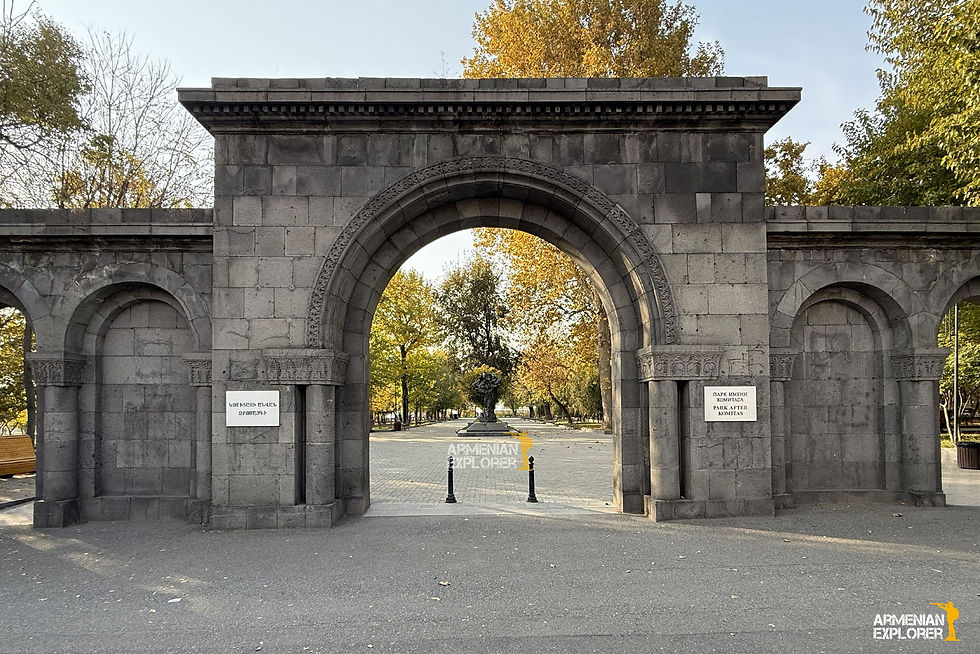
The entrance to Komitas Park
In 1936, one year after his death, the remains of Komitas, the great Armenian composer and ethnomusicologist, were reburied here, giving the pantheon its name.
In 1969, with the support of Stepan and Ruzan Kyurkchyan, a tuff-stone northern wall and decorative divider were constructed. The pantheon underwent major renovation in 2005.
Today, the Komitas Pantheon is the resting place of outstanding Armenian figures from many fields, including:
Cinema and theater
Music
Literature and poetry
Painting and architecture
Science
Politics
Sports
More Than Cemeteries
Pantheons are not ordinary burial grounds. They are places of memory, respect, and identity. In Armenia, both Yerablur and the Komitas Pantheon reflect the country’s struggle, culture, and creative spirit — silent yet powerful witnesses of national history.
Gallery


You May Also Like
How to Visit ROT54 (Aragats Scientific Center) – Full Guide

Shvanidzor’s 17th-Century Aqueduct: Armenia’s Ancient Engineering Marvel

Grigor Khanjyan’s Monumental Fresco at the Yerevan Cascade

From Stendhal Syndrome to Suren Syndrome

Tirinkatar Sacred Valley: Armenia’s High-Altitude Valley of Dragon Stones

How to Choose a Local Guide in Armenia

Komitas Pantheon in Yerevan

Gallery of Mineral Waters in Jermuk
